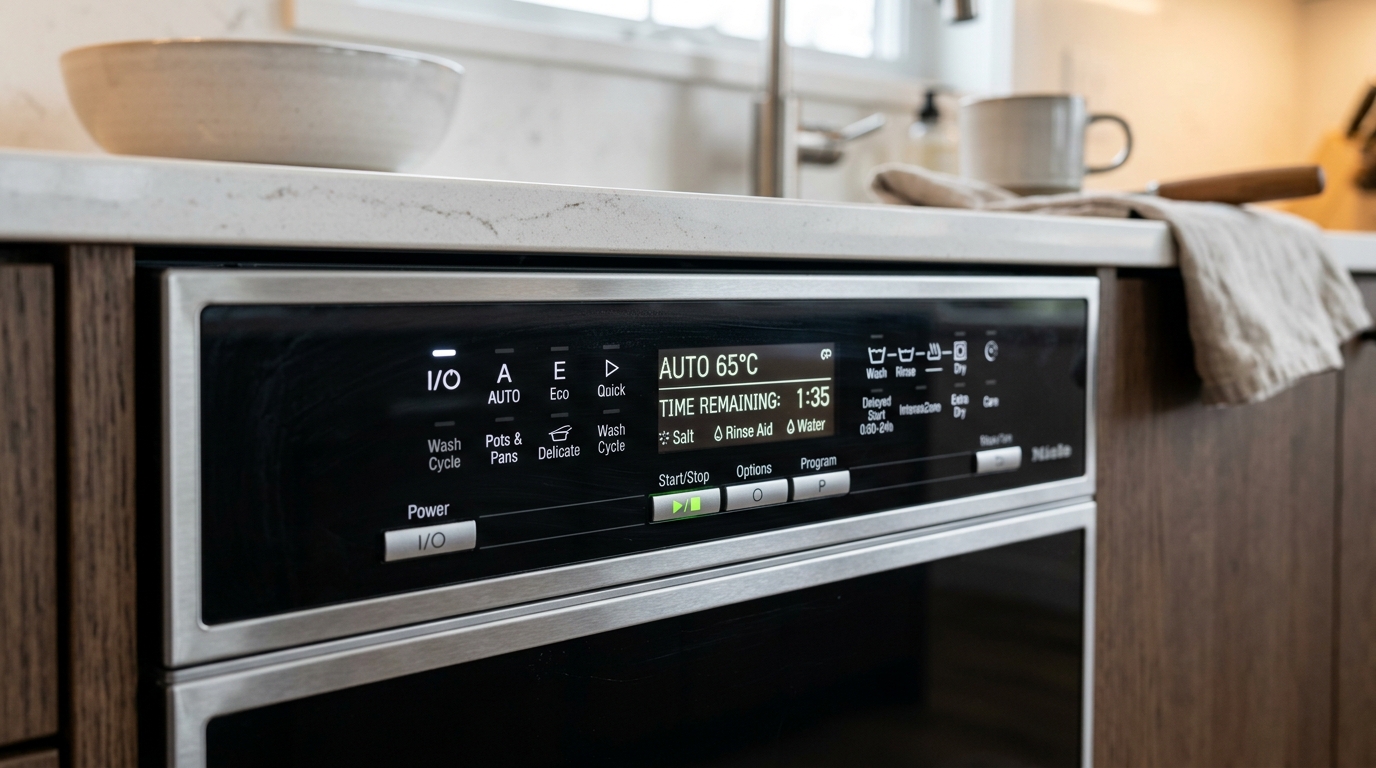
Bosch Dishwasher E25 Error Code: Step-by-Step Fix
Required Tools for this Fix
- Sponge
- Torx T20 screwdriver
Quick Summary Answer: The Bosch dishwasher error code E25 indicates that the appliance cannot drain water because the drain pump impeller is blocked, jammed, or the drain pump cover is loose or missing. To fix it, clear standing water from the tub, remove the filter system, pop off the pump cover, and pull out any debris like glass or seeds lodged around the impeller. Ensure you snap the pump cover back into place firmly until it clicks, as a loose cover will immediately trigger the E25 code even if the pump is clean.
An E25 error code on a Bosch dishwasher can bring your kitchen routine to a complete halt. This error specifically points to a drainage failure detected during the drain cycle.
Bosch dishwashers use an electronic sensor system to monitor water flow out of the sump basin. When the control board detects that water is not evacuating at the expected rate, it halts the cycle and displays E25 to prevent flooding.
In our years of field experience, this error is rarely caused by a burnt-out motor. Most of the time, the issue stems from a minor obstruction or an improperly seated plastic pump cover inside the sump basin.
SAFETY WARNING: Always disconnect electrical power to your dishwasher before performing any mechanical or electrical checks. Turn off the dedicated circuit breaker in your main breaker box or unplug the appliance from the wall outlet. Shut off the hot water supply valve under your sink to prevent accidental leaks while working.
Diagnostic & Repair Quick Reference Table
We compiled this reference guide to help you estimate the time, tools, and potential repair costs associated with resolving an E25 code on your Bosch unit.
| Diagnostic Step | Est. Time | Tools Needed | Est. Cost |
|---|---|---|---|
| Sump Clearing & Filter Cleaning | 10–15 mins | Sponge, Small Bucket, Towel | $0 |
| Drain Pump Cover & Impeller Inspection | 15–20 mins | Spoon handle, Needle-nose pliers, Flashlight | $0 |
| Drain Hose & Disposal Inlet Check | 20–30 mins | Screwdriver, Channel lock pliers, Bucket | $0 - $15 |
| Check Valve Inspection | 15–20 mins | Flathead screwdriver, Needle-nose pliers | $0 - $20 |
| Drain Pump Motor Multimeter Test | 30–45 mins | Torx T20 screwdriver, Digital Multimeter | $0 |
| Drain Pump Motor Replacement | 45–60 mins | Torx T20 screwdriver, Towels | $45 - $90 |
Understanding Why the E25 Error Triggers
Bosch dishwashers utilize a high-efficiency drain pump system that relies on precise hydraulic pressure. Water flows from the dishwasher tub through a multi-stage filter into the sump cavity.
From the sump, the drain pump forces water past a non-return check valve, through the drain hose, and out through your sink drain or garbage disposal. If any component in this pathway experiences a drop in flow speed, the system flags the E25 fault.
The error code is triggered by one of three core failure states:
- Physical Impeller Jam: Hard food particles, broken glass, fruit seeds, or plastic twist ties wrap around the impeller blades.
- Missing Pressure Seal (Loose Cover): The small plastic cover that sits over the impeller is unlatched or missing. Without this cover, the pump cannot create the suction pressure needed to push water up the drain hose.
- Downstream Restriction: A kinked drain hose, clogged air gap, or blocked garbage disposal inlet stops water from exiting the house plumbing.
The Critical Role of the Bosch Drain Pump Cover
We frequently see homeowners clear out the sump basin, remove a piece of debris, and still face an E25 code immediately afterward. This happens because the plastic drain pump cover was not reinstalled correctly.
The drain pump cover is a small, contoured piece of plastic located at the bottom of the sump cavity. It directs water flow directly into the impeller blades and forms a vacuum seal.
If this cover is left off, or if it is snapped in loosely, the impeller will spin in open water without generating directional lift. The control module registers that water level is not dropping and triggers the E25 error code.
When reinstalling this cover, you must push down and slide it until you hear a sharp, distinct snap sound. If you can wiggle the cover with your fingers, it is not fully locked.
Diagnostic Testing Step-by-Step Checklist
Work through this diagnostic checklist sequentially. We designed this flow to resolve the simplest, most common causes before moving to advanced component testing.
[ ] Step 1: Disconnect power and clear standing water from the tub.
[ ] Step 2: Remove and clean the micro-filter and mesh screen assembly.
[ ] Step 3: Remove the white plastic drain pump cover.
[ ] Step 4: Inspect the impeller blades for debris, hair, or glass.
[ ] Step 5: Verify free rotation of the pump impeller manually.
[ ] Step 6: Reinstall the pump cover until it distinctly clicks into place.
[ ] Step 7: Inspect the drain hose for kinks or crushed sections.
[ ] Step 8: Clean the garbage disposal connector and sink air gap.
[ ] Step 9: Test the check valve for stiff rubber or mechanical failure.
[ ] Step 10: Perform a electrical continuity test on the drain pump motor.
Detailed Step-by-Step Repair Instructions
Follow these clear instructions to troubleshoot and fix your dishwasher.
Step 1: Prep the Work Area and Remove Standing Water
Begin by shutting off electrical power to the unit at your main circuit breaker panel. Open the dishwasher door and pull out the lower dish rack to give yourself room to work.
If your dishwasher threw the E25 code mid-cycle, you will likely see an inch or two of dirty, standing water at the bottom of the tub. We recommend using a small plastic cup to scoop out the bulk of the water into a bucket.
Use a heavy-duty sponge or microfiber towel to soak up the remaining water in the sump pit beneath the filter. The sump pit must be completely dry so you can clearly see small shards of glass or wire debris.
Step 2: Remove and Clean the Filter Assembly
Locate the cylindrical filter assembly at the base of the dishwasher tub. Turn the top handle counterclockwise roughly a quarter turn to unlock it from the sump housing.
Lift the cylindrical filter assembly straight up and out of the machine. Separate the coarse mesh screen, the fine micro-filter, and the central cylinder.
Wash all filter components under warm tap water using a soft nylon brush and mild dish soap. Remove all greasy residue and food particles, then set the clean filter parts aside on a towel.
Step 3: Access and Inspect the Drain Pump Impeller Cover
Look down into the bottom-left side of the dry sump cavity. You will see a small, white or colored plastic cover held in place by a retaining tab or a single Torx screw, depending on your Bosch model series.
If your model has a retaining clip, push the tab inward and pull the cover off toward the front or side. If your model uses a T20 Torx screw, remove the screw first, then lift the tab out.
Examine the cover for cracked plastic, broken retaining tabs, or damaged rubber O-ring seals. If the plastic tab is snapped off, the cover will not stay sealed, and you must purchase a replacement cover to fix the E25 error.
Step 4: Clear the Pump Impeller Cavity
With the pump cover removed, look directly into the exposed impeller chamber using a bright flashlight. You will see a small set of plastic fan blades (the impeller).
Use needle-nose pliers or a small spoon handle to gently clear away any foreign material. Broken glass, olive pits, popcorn kernels, and twist-ties commonly bind these impellers.
Carefully insert your finger or a dull tool to spin the impeller blades. The impeller should turn with a slight, rhythmic magnetic resistance (it will feel like it snaps into set positions as it rotates).
If the impeller feels completely locked solid, or if it grinds harshly when rotated, there is debris wedged behind the shaft seal, or the pump bearings have failed mechanically.
Step 5: Reinstall the Pump Cover and Filter System
Once the impeller turns freely and the cavity is clear of sand and glass, line up the pump cover with its mounting slot.
Press down firmly on the cover until you feel and hear a hard “click.” Pull upward gently on the plastic lip to confirm that it cannot dislodge under water pressure.
Reassemble the stainless steel filter plate and the central micro-filter unit. Drop the assembly back into the sump base and twist it clockwise until the alignment arrows on the frame line up perfectly.
Step 6: Inspect the Drain Hose and Plumbing Connections
If clearing the sump pit does not clear the E25 error, the block is further down the drainage line. Open the cabinet door beneath your kitchen sink and trace the corrugated drain hose running from your dishwasher.
Look for sharp bends, tight loops, or heavy objects resting against the flexible hose. A squashed or kinked hose will restrict water flow and trigger the E25 sensor.
Disconnect the drain hose from the garbage disposal branch or the sink drain tailpiece connection. Use a pair of pliers to slide back the spring clamp, then pull the hose off the plastic nipple.
Use a small screwdriver or wooden dowel to scrape inside the disposal connection nipple. Built-up grease, food sludge, and calcified minerals often form a hard plug at this specific junction point.
If you recently installed a new garbage disposal unit, verify that the internal plastic knockout plug was removed. If the installer forgot to punch out this plug, the dishwasher cannot drain, resulting in an immediate E25 error on the first cycle.
Step 7: Check the Rubber Non-Return Check Valve
Inside the sump cavity, just upstream of the pump output, sits a small rubber check valve flapper. This valve allows dirty water to leave the tub while preventing sink water from flowing backward into your clean dishes.
Pull the rubber check valve out of its seating groove using needle-nose pliers. Inspect the rubber blade to ensure it remains soft, pliable, and free from tears or calcified scale build-up.
Rinse the check valve under hot water to remove grease. Push it firmly back into its retention slot, making sure the flat rubber leaf swings outward toward the drain path without binding.
Advanced Diagnostic: Testing the Drain Pump Motor
If the impeller is clear, the cover is snapped tight, and the plumbing line is open, the drain pump motor itself may have suffered an electrical fault. We can test the pump motor using a digital multimeter set to check resistance (Ohms).
Accessing the Drain Pump Motor
Restore safety precautions and ensure power remains completely disconnected from the home breaker panel.
On most modern Bosch dishwashers, you access the drain pump motor from the front lower kickplate panel or by lowering the bottom pan access shield.
- Remove the two Torx T20 screws holding the lower metal toe kick plate under the door.
- Tilt the lower cover plate downward and pull it away from the frame.
- Locate the drain pump, which is mounted directly to the plastic sump housing near the front-left corner.
- Press the small plastic locking tab on the wire harness connector and pull the harness straight off the pump terminals.
Measuring Motor Winding Resistance
Set your digital multimeter to the lowest Ohms ($\Omega$) scale setting (typically 200 ohms). Touch one probe lead to each of the metallic contact pins inside the terminal socket on the pump motor.
- Standard AC Drain Motors: A healthy motor winding will typically display a resistance reading between 75 and 100 Ohms.
- Modern BLDC (Brushless DC) Motors: These three-pin pumps should yield equal resistance readings across all three pin combinations (1 to 2, 2 to 3, 1 to 3), usually reading between 20 and 30 Ohms.
If your meter displays “OL” (Open Loop) or an infinite resistance value, the copper motor windings inside the pump have burned out. If the meter shows 0 Ohms, the internal coil has shorted out.
In either case, you must replace the drain pump assembly.
Checking for Ground Faults
Keep one multimeter probe touching a metallic electrical pin on the motor housing, and touch the second probe to the unpainted metal casing or ground tab of the pump body.
The meter should show an open circuit (“OL”). If you get a specific numeric resistance reading, the pump has an internal short-to-ground fault and must be replaced immediately to avoid electrical hazards.
How to Clear and Reset the Bosch E25 Error Code
Clearing the E25 code from the dishwasher memory module is simple once you complete the physical repairs.
- Close the dishwasher door completely.
- Press and hold the Start button down firmly for three to five seconds.
- The digital display screen will change to
0:01or0:00, indicating that the current cycle was canceled. - Close the door and wait roughly one minute while the control unit runs a brief drain clear sequence.
- Once the timer reaches
0:00, turn the power button off. - Switch off the home circuit breaker for 60 seconds to clear the cache, then turn power back on.
- Select a standard rinse cycle and run the machine to verify that water drains properly without throwing an error.
Preventative Maintenance to Prevent E25 Recurrence
Taking a few proactive care steps will keep your Bosch dishwasher operating smoothly and protect the pump system from recurring E25 faults.
Scraping vs. Rinsing Dishes
We recommend scraping solid food particles, bones, fruit seeds, and large debris into your trash can or compost bin before loading plates into the racks.
However, you do not need to wash dishes completely clean before loading them. Modern Bosch dishwashers rely on food enzymes present on dirty dishes to break down grease properly during the wash sequence.
Regular Sump and Filter Maintenance
Rinse your stainless steel micro-filter under warm running water once every two to four weeks. Grease and limescale build up inside the tiny mesh pores over time, restricting flow into the sump pit and overworking the pump motor.
Routine Vinegar Maintenance Cycles
Once a month, run a hot cleaning cycle to dissolve grease buildup within the drain lines. Place a dishwasher-safe bowl filled with two cups of white distilled vinegar on the top rack of your empty dishwasher and run a standard auto cycle.
The acid in the vinegar cuts through hard water minerals, soap scum, and fatty grease deposits resting inside the internal drain pump impeller cavity and check valve pathways.
Frequently Asked Questions
Why does my Bosch dishwasher show E25 even when there is no water left inside?
The E25 code tracks flow resistance and motor current load, not just water level sensors. If the impeller is jammed by a small item or the drain pump cover is missing, the control board records an error status during the drain phase and locks out the unit until manually reset.
Can I run my Bosch dishwasher without the plastic pump cover installed?
No. Operating the dishwasher without the pump cover installed will cause an immediate E25 error code every single time. The pump relies on that tight plastic shroud to create the vacuum pressure needed to push water up through the drain hose and out of the machine.
How do I manually drain water out of my dishwasher if it is full?
The safest manual method is to turn off power to the machine, open the door, remove the bottom rack, and scoop out the water using a small cup and sponge. Alternatively, you can drop the end of the drain hose into a shallow floor bucket beneath sink level to let gravity drain the tub.
Will a clogged garbage disposal trigger a Bosch E25 code?
Yes. Bosch dishwashers often vent their drain lines directly into the side port of your garbage disposal unit. If the disposal inlet becomes packed tight with food scrap sludge, water back-pressures into the dishwasher drain hose, triggering an E25 drain fault error.
How do I know if my drain pump motor needs complete replacement?
Your drain pump motor requires replacement if it receives correct voltage from the main control board but fails to spin, produces a loud high-pitched grinding sound, shows an “Open Loop” (OL) reading during a multimeter test, or has visible physical cracks in the housing body.
Safety Precaution Notice
Before proceeding with any repair checklist: Always unplug the appliance from its electrical socket and turn off shutoff valves for incoming water (for washers and dishwashers). Discharge capacitors if working on motors.