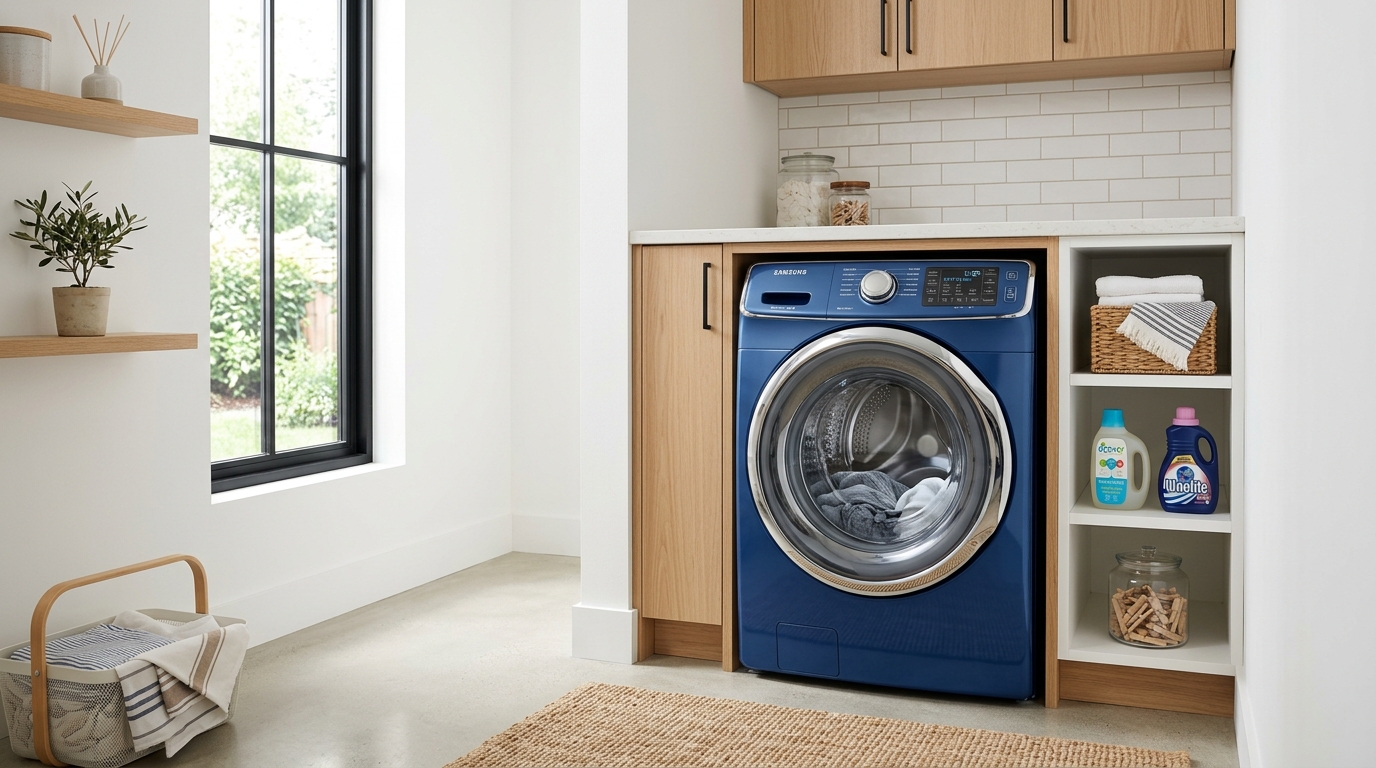
Samsung Washing Machine 4C Error Code: Step-by-Step Fix
Required Tools for this Fix
- Pliers
- Bucket
- New inlet hose
Quick Summary Answer: The Samsung 4C error code (formerly displayed as 4E) indicates a water supply fault where your washing machine is not detecting water filling the tub within the specified time. This is most commonly caused by fully or partially closed home supply valves, clogged mesh filter screens at the inlet connections, or kinked fill hoses. To fix it, verify that your wall valves are fully open, straighten out the supply hoses, and clean any debris out of the inlet mesh filters.
An unexpected 4C code on your Samsung washing machine panel stops your wash cycle dead in its tracks. This error code is your machine’s way of telling you that water is not entering the drum fast enough or at all. Modern electronics continuously monitor fill rates, and if the water level sensor does not detect a change within roughly 15 to 20 minutes, the cycle halts to protect the internal heater and pump.
We see this specific fault code daily in the appliance repair industry. While it looks concerning, over 80 percent of 4C errors stem from simple external plumbing issues that you can fix without calling a professional.
⚠️ WARNING: ELECTRICAL AND WATER SAFETY FIRST Always unplug your Samsung washing machine from the electrical wall outlet before removing access panels or handling internal electrical components. Turn off both hot and cold water shut-off valves at your home connection points before disconnecting fill hoses to prevent sudden flooding.
Quick Diagnostic Breakdown
We created this quick diagnostic summary to help you gauge the time, tools, and expense required for each troubleshooting stage.
| Diagnostic Step | Est. Time | Tools Needed | Cost |
|---|---|---|---|
| 1. Valve & Hose Inspection | 5 mins | None | $0 |
| 2. Hose Kink & FloodSafe Check | 5 mins | Channel-lock pliers | $0 - $15 |
| 3. Mesh Filter Screen Cleaning | 10 mins | Needle-nose pliers, soft brush | $0 |
| 4. Detergent Drawer Inspection | 10 mins | Warm water, stiff brush | $0 |
| 5. Water Inlet Valve Multimeter Test | 20 mins | Screwdriver, Multimeter | $0 - $45 |
| 6. Pressure Sensor System Check | 25 mins | Screwdriver, Pliers | $0 - $35 |
| 7. Control Board Inspection | 30 mins | Screwdriver | $100 - $250 |
Step-by-Step Diagnostic Checklist
Follow this systematic sequence to isolate and repair the source of the 4C error code quickly.
- Check Home Shut-Off Valves: Ensure both hot and cold supply spigots at the wall are fully open.
- Inspect Water Pressure: Verify that household water pressure meets the required 20 to 120 PSI range.
- Inspect Fill Hoses: Look behind the machine for pinched, twisted, or flattened hoses.
- Remove Auto-Shutoff Hoses: Swap out any “FloodSafe” smart hoses for standard stainless steel braided lines.
- Clean Water Inlet Screens: Remove sediment build-up from the cold and hot mesh filters inside the rear water connections.
- Clear Detergent Dispenser: Clean out hardened detergent blockages inside the dispenser drawer housing.
- Test Water Inlet Valve Solenoids: Check electrical continuity and resistance across the valve terminals using a multimeter.
- Inspect Pressure Transducer Hose: Check the air hose leading to the water level sensor for kinks, holes, or water blockages.
Understanding the 4C and 4E Error Codes
Samsung washers share similar error code structures across different generations. The 4C code replaced the older 4E code on newer digital displays, but both signal the exact same underlying problem: a lack of water inflow.
In some cases, you might also see variations like 4C2 or 4E2. A 4C2 code specifically indicates an issue with the hot water supply, often triggered when the machine detects cold water entering during a hot cycle or vice versa.
If your washer screen reads NF or 1 4C, these are additional variations meaning “No Fill.” Regardless of the exact alphanumeric variant, your diagnostic path remains focused on restoring proper water volume and pressure.
Step 1: Inspect Household Water Valves and Supply Pressure
Before taking apart your appliance, we must verify that your home plumbing system is supplying sufficient water to the unit.
Checking the Supply Valves
Locate the water supply spigots behind your washing machine. Turn both the hot and cold knobs completely counterclockwise to ensure they are fully open.
Sometimes, gate valves can break internally, leaving the valve closed even when the handle appears open. If the handle spins freely without resistance, the valve stem may be stripped.
Performing the Bucket Flow Test
Turn off the valves, disconnect both supply hoses from the back of the washer, and direct the open hose ends into a five-gallon bucket. Turn the wall valves back on fully to test water volume.
You should see a strong, solid stream of water coming from both lines. If the flow is weak or trickles out slowly, your home water supply pressure is below the 20 PSI threshold required by Samsung electronic valves.
If you have low water pressure throughout your home, contact a licensed plumber to inspect your pressure-reducing valve or main supply line.
Step 2: Hose Diagnostics and the Danger of FloodSafe Hoses
Damaged fill hoses directly restrict water passage and trigger sudden 4C errors mid-cycle.
Checking for Physical Restrictions
Pull your washer a few inches away from the wall and inspect the fill hoses. Ensure there are no sharp bends, kinks, or weight pressed against them from the rear of the machine housing.
Over time, rubber fill hoses can weaken, collapse internally, or warp under pressure. We suggest replacing aging rubber hoses with high-quality braided stainless steel lines every five years.
Replacing FloodSafe Hoses
Many homeowners install “FloodSafe” fill hoses, which feature automatic shut-off valves designed to snap shut if they detect high flow rates.
Samsung washing machines pull water rapidly using quick-actuating solenoid valves. This sudden demand for water tricks FloodSafe mechanisms into shutting off the supply automatically, creating a immediate 4C code.
We strongly advise replacing auto-shutoff hoses with standard, heavy-duty braided stainless steel hoses to prevent false triggers.
+-----------------------------------------------------------+
|               FILL HOSE CLEARANCE DIAGRAM                 |
+-----------------------------------------------------------+
|                                                           |
|    [ WALL SPIGOT ]                                        |
|           |                                               |
|           |  <--- Maintain smooth, sweeping curves       |
|           |                                               |
|           +-------------------+                           |
|                               |                           |
|                   [ WASHER REAR INLET ]                   |
|                   (Minimum 4-inch gap)                    |
|                                                           |
|   ❌ AVOID sharp bends, heavy kinks, or wall pinching    |
+-----------------------------------------------------------+
Step 3: Cleaning the Mesh Water Inlet Filters
The most frequent culprit behind a Samsung 4C code is debris blocking the small inlet filter screens.
Your home’s municipal water or private well system carries tiny bits of sediment, rust, and mineral scale. The mesh filter screens resting inside the washer’s water connections catch this debris before it can damage the internal valves.
How to Remove and Clean the Filters
- Power Down and Shut Off Water: Unplug the appliance and turn off both supply spigots completely.
- Disconnect the Hoses: Unscrew the cold and hot water fill lines from the back inlet ports of the washer using channel-lock pliers.
- Extract the Mesh Screens: Look inside the threaded plastic ports on the back of the washer. Use needle-nose pliers to gently pull the small plastic mesh filters straight out.
- Scrub and Rinse: Wash the filter screens under warm running water using an old toothbrush. If mineral scale is hardened on the mesh, soak the filters in warm white vinegar for 15 minutes.
- Reinstall: Push the clean screens securely back into their housing slots. Reattach your hoses tightly, turn on the water valves, and inspect for leaks before running a test cycle.
Never operate your washer without these screens installed. Doing so allows grit directly into the solenoid valves, causing them to leak or fail permanently.
Step 4: Clearing Detergent Dispenser Housing Clogs
Water does not pour directly into the tub; it travels through the top detergent dispenser drawer first.
If the internal spray nozzles above the detergent tray become clogged with thick liquid fabric softener or dried powder, water cannot flow into the drum efficiently. The control board interprets this slow water passage as an inlet valve failure.
Cleaning the Dispenser Housing
Pull the detergent drawer outward until it stops, then press down on the release tab located near the fabric softener compartment to remove it completely.
Inspect the top ceiling inside the empty drawer cavity. Use a small flashlight to check for scale or dried soap clogging the small water exit holes.
Scrub the inside of the housing and the drawer assembly using warm water and a stiff nylon brush. Rinse the drawer thoroughly, slide it back into place, and test for proper water flow.
Step 5: Testing the Water Inlet Valve with a Multimeter
If your hoses, pressure, and filter screens are clear, the component most likely to fail is the internal water inlet valve.
The water inlet valve uses electrical solenoids to pull open internal rubber diaphragms when receiving signal voltage from the control board. If an electrical coil inside the valve burns out, or if the internal port fills with lime scale, the valve stays shut.
+-----------------------------------------------------------+
|             WATER INLET VALVE TESTING GUIDE               |
+-----------------------------------------------------------+
|                                                           |
|             +-------------------------------+             |
|             |   MULTIMETER: SET TO OHMS (Ω) |             |
|             +---------------+---------------+             |
|                             |                             |
|                    [ Probe ] [ Probe ]                    |
|                        |         |                        |
|                       (o)       (o)   <-- Valve Terminals |
|                     +---------------+                     |
|                     | VALVE SOLENOID|                     |
|                     +---------------+                     |
|                                                           |
|   NORMAL READING: 2.0k Ω to 4.0k Ω (2,000 - 4,000 Ohms)   |
|   FAULTY READING:  0 Ω (Short) or OL / Infinity (Open)    |
+-----------------------------------------------------------+
Accessing the Valve
Unplug the washing machine from the wall outlet. Remove the top panel screws on the rear of the machine and slide the top cover back to access the water valve assembly.
Electrical Testing Procedure
Disconnect the wire harness plugs attached to the inlet valve solenoids. Set your digital multimeter to measure resistance in Ohms (Ω).
Touch your multimeter probes to the two metal terminals on each individual solenoid coil. A functioning Samsung water valve solenoid should measure between 2.0k Ω and 4.0k Ω (2,000 to 4,000 Ohms).
If your multimeter displays “OL” (Open Loop) or zero resistance, the solenoid coil has failed electrically and you must replace the entire inlet valve assembly.
Checking Mechanical Failure
Even if the valve passes the electrical resistance test, its internal mechanical diaphragm can fail.
If you hear the valve humming loudly during a fill cycle but no water enters, physical scale is likely locking the internal plunger. Replacing the water inlet valve is the only permanent solution for a mechanically jammed component.
Step 6: Inspecting the Water Level Sensor (Pressure Switch)
The main control board relies on a water level sensor (pressure transducer) to know how much water has entered the tub.
If the water level sensor fails or its air pressure tube becomes blocked, the computer assumes no water is entering the tub—even if it is filling up rapidly—and shuts off power while displaying the 4C code.
Inspecting the Air Tube
Locate the small, clear flexible air tube connecting the bottom of the outer tub to the pressure switch mounted near the top frame of the washer.
Inspect this air hose along its entire length. Look for kinks, holes, or thick soap scum trapped near the bottom tub trap.
Disconnect the hose top and blow firmly into it to clear out any trapped water or debris. Reattach the tube tightly so no air pressure escapes during filling.
Testing the Sensor Connections
Check the small wiring harness attached to the pressure sensor. Look for loose pins, corrosion, or damaged wires caused by drum vibration during high spin speeds.
If the wiring is intact and the air line is completely clean, but the washer refuses to acknowledge water entering the drum, replace the water level pressure sensor.
Step 7: Checking Control Board and Wiring Harnesses
If all components pass mechanical and resistance tests, the problem lies within the electronic control system.
The main control board contains small solid-state relays (TRIACs) that supply 120 volts AC directly to the water inlet valves. If a voltage spike damages these circuits, the control board cannot signal the water valves to open.
Visual Control Board Inspection
Unplug the unit and remove the main control module cover. Inspect the circuit board visually for visible burn marks, popped capacitors, or melted trace lines.
Look carefully at the wire harness connections between the control board and the water valve. Re-seat loose molex connectors to restore solid electrical contact.
If the board shows obvious short-circuit damage or fails to send 120V to the valve solenoids during a live fill command, you must replace the main control board.
Front-Load vs. Top-Load Specific Fixes
While both configurations share identical internal valve logic, layout differences impact troubleshooting.
Front-Load Samsung Washers
Front-load models depend heavily on correct door latch signaling before opening the inlet valves.
If the door lock assembly fails to confirm it is fully latched, the control board halts the fill process, occasionally throwing a 4C code alongside door error codes. Make sure the front door closes flush against the rubber boot.
Additionally, front-load units rely on precise internal baffle sprays. Check for soap residue buildup near the door bellows nozzle.
Top-Load Samsung Washers
Top-load Samsung units use longer, flexible supply tubes that shift during out-of-balance tub movements.
Inspect the rear upper access point to ensure these longer internal tubes have not pinched against the steel cabinet during severe vibration.
Top-load models also feature dual or triple-stage water valves mounted directly near the top back console. Ensure you test all individual solenoid sets on multi-valve models.
Preventative Maintenance Practices
To keep your Samsung washing machine running smoothly and avoid future 4C error codes, adopt these simple maintenance habits:
- Clean Inlet Mesh Screens Semi-Annually: Clean your water inlet screens every six months to eliminate buildup before it chokes off water flow.
- Ditch Auto-Shutoff Hoses: Use heavy-gauge standard stainless steel braided hoses rather than mechanical FloodSafe designs.
- Flush Household Water Lines: If your city performs water main maintenance, run your outdoor hose bibs for a few minutes before running your washer to clear out sediment.
- Use High-Efficiency (HE) Detergent: Always use low-foaming HE soap to prevent excessive foam from backing up into the pressure switch hose.
- Inspect Hoses Annually: Feel along your fill hoses once a year to detect softening, cracking, or internal pinch points early.
Frequently Asked Questions
Can low water pressure cause the Samsung 4C error?
Yes, low household water pressure frequently triggers the 4C code. Samsung washing machines require a incoming line pressure of at least 20 PSI to force open the internal diaphragms of the water inlet valves. If your pressure drops below this threshold, the tub fills too slowly and the control board registers a fill timeout error.
How do I clear or reset the 4C code on my Samsung washer?
To clear the code, press the Power button to shut off the machine, then unplug it from the wall outlet for two minutes. While powered down, correct the underlying water supply issue (such as opening closed valves or cleaning mesh screens). Plug the machine back in and start a fresh cycle to clear the error memory.
Why does my washer display 4C even though water is flowing into the tub?
If water flows into the tub but the 4C code still appears, your machine is not measuring the rising water level correctly. This points to a clogged pressure sensor air tube, a faulty water level switch, or severe sediment buildup in the detergent dispenser that slows the water down before it hits the drum.
What is the difference between Samsung error codes 4C, 4E, and NF?
All three error codes indicate the exact same water supply fault. The code 4E is displayed on older Samsung models manufactured prior to 2014, 4C is the standard code on modern digital models, and NF stands for “No Fill” on select older or commercial display models.
Is it safe to bypass or remove the mesh filter screens?
No, we strongly advise against removing the inlet mesh filter screens permanently. Removing these filters allows rust particles, hard water minerals, and sand directly into the internal water valve assembly. This debris will jam the solenoids open, leading to sudden home flooding or valve failure.
Safety Precaution Notice
Before proceeding with any repair checklist: Always unplug the appliance from its electrical socket and turn off shutoff valves for incoming water (for washers and dishwashers). Discharge capacitors if working on motors.